
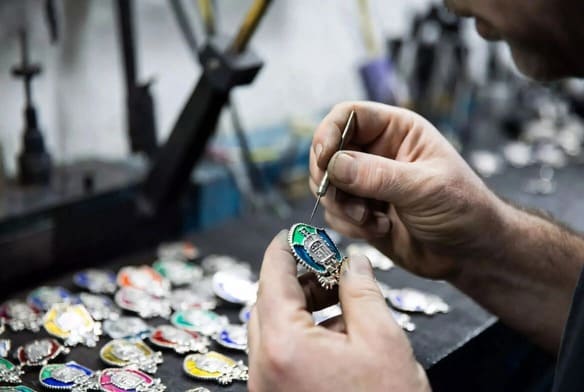
TL;DR: Making an enamel pin is a six-stage process — design a vector file, pick your enamel type and plating, get quotes, approve a pre-production sample, manufacture (10-25 days), then ship and pack. A standard run of 100 soft enamel pins usually runs $200 to $350.
Pin Anatomy: The Six Components That Drive Your Quote
An enamel pin is six physical components glued, welded, and stamped together. Every one of them shows up as a line item on your quote.
- Metal base. Zinc alloy handles complex shapes and internal cutouts via die-casting. Iron and brass are for traditional die-striking. Zinc alloy setups can carry slightly different mold fees than iron, depending on the factory.
- Recessed mold. The cavities stamped or cast into the base metal. Fixed upfront cost, usually $40 to $60, scaled to the overall size of the pin.
- Plating layer. Thin metallic coating over the raw base — gold, silver, black nickel, the works.
- Enamel fill. Colored paint injected into the recessed areas. Factories price by color count. Standard quotes cover 1 to 7 colors; an 8th color triggers a per-unit upcharge.
- Backing post. The sharp needle welded to the back. Anything over 1.5 inches needs two posts or it’ll spin on whatever it’s pinned to.
- Clutch. The fastener. Rubber clutches cost fractions of a cent and are standard. Locking clutches cost more.
Hard Enamel vs. Soft Enamel — The Decision That Shapes Everything Else
Hard enamel pins are polished flat to the metal for a premium finish. Soft enamel pins have recessed enamel that leaves visible metal ridges. This single choice cascades into your manufacturing steps, your durability, and your unit cost.
Hard enamel. Workers overfill the metal cavities with enamel, bake the pin at high heat, and grind the surface flat until the metal lines and colored areas sit entirely flush. The result is a smooth, jewelry-like surface that resists scratching. The extra labor and the high-heat baking are what you’re paying for. A run of 100 to 500 units lands around $2.50 to $6.00 per pin [Source: hesank.com/what-youll-actually-pay-for-custom-pins]. Corporate brands and high-end merchandise lines tend to prefer this style.
Soft enamel. Workers fill the cavities below the level of the metal borders. After baking, the enamel shrinks slightly, leaving a textured, dimensional feel — you can run your fingernail over the raised metal lines and feel every one of them. Soft enamel averages $1.50 to $4.00 per pin [Source: hesank.com/what-youll-actually-pay-for-custom-pins]. Independent artists usually go this route, partly for the classic “trading pin” look, partly because the cheaper unit cost protects your retail margin.
| Feature | Hard Enamel | Soft Enamel |
|---|---|---|
| Surface | Smooth, flush | Textured, recessed |
| Cost (100 units) | ~$250 – $600 | ~$150 – $400 |
| Durability | High (scratch resistant) | Moderate |
| Detail Limit | Slightly thicker lines needed | Holds finer details |
Designing a File the Factory Won’t Send Back
Pin designs need to be submitted as vector files with line weights of at least 0.2mm and metal gaps of at least 0.3mm between enamel colors. Submit a raster file straight out of Procreate and you’ve already lost a week to revisions. Factories need Adobe Illustrator (.ai) or vector PDF to program their CNC mold-cutting machines.
Mechanical limits that matter:
- Minimum metal line weight: 0.2mm [Source: enamelpinfactory.com]. The raised metal borders separating your colors can’t be thinner than this. They’ll break during die-striking or just disappear during polishing.
- Minimum enamel area: 0.3mm wide [Source: gumtoo.com]. The factory injects enamel with a fine needle. If the gap’s too narrow, the liquid simply doesn’t flow.
- Text. Simple fonts, nothing smaller than 5pt. Helvetica’s fine. Don’t get cute.
- No gradients. Enamel is solid liquid paint — you can’t print a fade. If your design really needs a gradient, you’re looking at an offset printed pin with an epoxy dome, which is a different product entirely.
- Specify colors with the Pantone Solid Coated book. RGB and CMYK do not map cleanly to physical paint.
Picking a Plating Finish (And the Combinations That Fail)
Plating coats your base metal in gold, silver, black nickel, antique copper, and so on. It’s the visible outline around every colored segment of your design.
Some platings degrade fast. Rose gold and copper are notorious for it. Pin designer Shannon Talbott has documented rose gold plating turning a dark, rusty color over time as it oxidizes, and a lot of creators have just abandoned it for standard gold or dyed metal [Source: shannontalbott.com]. Standard gold holds up far better. I keep meaning to give rose gold another shot — the color when it’s fresh is genuinely beautiful — but I’ve been burned enough times that I default to gold and don’t argue with myself about it anymore.
Black nickel is everywhere in indie art pins, and for good reason: it looks expensive. But it creates optical issues if you pair it with dark enamel. Because the metal outlines are dark, navy blue or deep purple enamels bleed into the borders and the pin reads as muddy from any kind of distance. If you’re going black nickel, push your Pantones one or two shades lighter than your gut tells you to.
Finding and Vetting a Manufacturer
You’ve got three real options: domestic broker-resellers, direct Chinese factories via Alibaba, or independent factory sites. Brokers handle the language barrier and quality control for you, and they charge for it. Direct factories give you the lowest unit price but you’re on the hook for every spec.
Maker communities on Reddit (r/EnamelPins, mostly) actively track factory performance, which is more useful than any glossy “best of” list. The Monterey Company gets recommended a lot for difficult projects, particularly hard enamel with antique plating [Source: reddit.com/r/EnamelPins]. GSJJ is highly rated for speed, though users note it operates more as a high-volume broker than a true factory.
When you’re vetting someone new:
- Green flags. They ask for vector files. They send back a digital proof showing exactly where metal lines will sit. They name the Pantone numbers they plan to use, in writing.
- Red flags. They accept a low-resolution JPEG without flinching, or they won’t separate the mold fee from the unit cost on the quote.
Reading and Negotiating a Quote
A professional pin quote separates the fixed mold fee from the variable unit cost. Volume drives the math. For a standard 1.5-inch, 2-color soft enamel pin, Alchemy Merch publishes a useful baseline: 50 pins runs roughly $195, while 100 pins runs $235 [Source: alchemymerch.com]. Doubling your inventory only adds $40, because that fixed mold setup gets spread across more units. At 500 units, you’re around $575.
Reordering the exact same design is cheaper because the factory keeps your mold on the shelf. A second run of 50 pins drops from $195 to $145 [Source: alchemymerch.com]. Worth knowing before your first run — order a little small, see if it sells, reorder.
Check for hidden line items. Confirm the specific backing attachments you want are included. Ask whether shipping is included, because air freight on heavy metal often tacks $40 to $80 onto a small order.
Pre-Production Samples — Why Skipping This Costs More Than It Saves
A pre-production (PP) sample is one physical pin, manufactured and photographed before the factory runs your full order of 100 or 500. It costs an extra $30 to $80 and adds a week to your timeline. Skipping it is how people lose entire orders.
Digital proofs can’t simulate physical paint. Enamel colors are hand-mixed on the factory floor. Reds dry darker than the Pantone swatch suggests, oranges can shift yellow [Source: nightowlsprint.com]. The PP sample is your one chance to catch it.
When you get the sample photos, look hard. Enamel underfill (paint dipping below the metal line), plating tarnish, missing metal gaps. If a detail looks clustered or muddy in the sample, tell them to thicken the metal line before they strike the remaining 99.
Production Timeline and What Can Go Wrong
A standard order takes 3 to 4 weeks from digital proof approval to the box landing on your doorstep [Source: madebycooper.com]. The physical steel mold alone takes several days to cut. Soft enamel moves faster than hard because it skips the polishing stage.
Expect defects. The whole process leans on manual labor — workers use syringes to inject paint by hand, which is exactly as imprecise as it sounds. Pins with minor flaws get classified as “seconds” or “B-grades.” Across maker communities, a 5% to 20% defect rate is considered normal factory tolerance [Source: reddit.com/r/EnamelPins].
So if 15 out of your 100 pins have slight paint overfill or tiny dust specks, you keep them, mark them as B-grades, and sell them at a discount. That’s the deal. If the error rate goes above 20%, or the factory shipped you the entirely wrong color, then you’ve got grounds to push for a remake or credit.
Packaging, Backing Cards, and Presentation
How you package the pin determines its perceived value, and this is the part most first-time creators underthink.
The default attachment on most orders is the butterfly clutch — the metal clasp with two squeeze tabs. But Dream Maker Pins and a number of other top factories now default to black rubber clutches instead. Rubber holds tighter on denim and canvas, doesn’t catch hair, and won’t scratch skin on hats or collars [Source: dreammakerpins.com]. For premium protection, upgrade to locking clutches: deluxe flathead or ball-locking styles with an internal gripping mechanism that locks onto the pin shaft. Users release them with a tool-free “pinch and pull” motion [Source: studiodais.co.uk]. Costs slightly more. Ita-bag collectors heavily prefer them.
Custom backing cards turn a loose pin into a retail product. Expect $0.15 to $0.30 per printed backing card if the factory assembles them for you. Honestly the cheapest upgrade in the whole process.
Can You Actually Make Enamel Pins at Home?
You can’t make real enamel pins at home — they need industrial die-striking and kiln firing — but home-made alternatives using UV resin or acrylic can mimic the look well enough to prototype. Stamping zinc alloy and hand-polishing high-heat enamel just isn’t happening in your apartment.
For prototyping, a lot of artists use shrink plastic (NuFun Shrink with Ink film is the common one). Print your design onto the film with a standard inkjet, cut it out, bake it, and the plastic shrinks and thickens. Add a dome of clear UV resin on top and you’ve replicated the glossy, domed look of an epoxy-coated pin [Source: acountrygirlslife.com].
Another method: buy blank metal shapes and trace your design with Ranger Enamel Accents, a craft fluid that dries hard and mimics cold enamel [Source: instructables.com]. Fine for personal use or a friend’s birthday. They don’t have the weight or durability you need to sell at retail.
FAQ
How much does it cost to make 100 enamel pins?
A run of 100 soft enamel pins typically costs $200 to $300. 100 hard enamel pins runs $250 to $600. Per-unit cost drops sharply as you order more.
What’s the difference between hard and soft enamel pins?
Hard enamel is baked and polished flat to the metal for a smooth, premium finish. Soft enamel has recessed paint, so the raised metal borders are tactile and visible. Soft enamel is cheaper, hard enamel is more durable, and the look is genuinely different — it’s worth ordering a sample of each from any factory you’re considering before you commit. People underestimate how much the surface texture changes the feel of the product in hand, and once you’re holding both side by side the choice usually makes itself.
Can I design enamel pins in Procreate?
No. You need to vectorize the design in Illustrator or equivalent so the factory’s CNC machines can read the exact metal line paths.
How long does it take to manufacture enamel pins from start to finish?
3 to 4 weeks from approved proof to shipment landing — 10 to 25 production days plus freight.